Rolling Stones Album: Exile on Main St.
Release Date: May 12, 1972
Label: Rolling Stones
Popular Songs:
Songs You Need to Listen To:
- Sweet Virginia (YouTube)
- All Down the Line (YouTube)
- Let It Loose (YouTube)
- I Just Want to See His Face (YouTube)
- Torn and Frayed (YouTube)
Review Written By: Andy Trcka
August 19, 2023
In May 1972 the Rolling Stones released Exile on Main St., a double LP widely regarded as a classic and revered by many as their best work. In its sprawl, Exile on Main St. dabbles in the sounds typical of the Stones including: soul, rock, and blues. However, Exile is noteworthy not because it is a collection of enjoyable songs and familiar Stonesy influences, but because it offers intimate access to the band, a level of intimacy not typical of the Rolling Stones. Musically, Exile has an organic feel that is not replicated to the same degree elsewhere in the Stones’ catalog. Lyrically, Exile is an uninhibited glimpse into the Stones’ personal lives. Within Exile you’ll hear the Stones boast of: sexual exploits, champion a political cause, wade through love loss, and deliver songs with a gospel-soaked religious veracity that rivals any cathedral choir. Playing like a concert, Exile on Main St. is an album you don’t just listen to, as much as experience. Recorded in a mobile studio and in the basement of a mansion in the French Riviera, Exile was produced with little regard for convention. As such, the circumstances surrounding the recording of the album, and its contributing musicians, are as legendary as the record itself. A handful of decades separate these words from the release of the album, yet it’s reputation gains in notoriety. Monumental, pinnacle, masterpiece, triumph, legendary, top-of-their-game;these and countless other accolades have been hoisted upon Exile.
Within “Shine A Light,” the 2008 Martin Scorsese movie that chronicles a Stones concert, the camera catches Bill Clinton, Martin Scorsese, and Mick Jagger chatting before the show. The topic of their conversation wasn’t anything special, mostly chit-chat and minor specifics about the event. In fact, some folks have criticized Scorsese for including the scenes that feature President Clinton as unnecessary. I contest this scene was included not to highlight Clinton’s involvement in the project, but rather to illustrate Mick Jagger’s defining characteristic – he is a showman. Partway through their exchange Mick interrupts Clinton; he just cuts right in. I don’t know how often a President is interrupted, but I am guessing not regularly. Initially I was irritated, “c’mon Mick, the sound, lighting, or whatever will be fine…don’t cut off a President!” Mick was flexing an assertiveness that bordered on narcissism. Here we see the showman, the performer; Mick cares about his craft. The show, the music, and the experience that is the Rolling Stones is everything to Sir Jagger. This standard of excellence extends to their recordings. Stones albums feature expertly crafted songs, diligently mastered, and released via high-quality formats. Beyond everything else in his orbit, Mick cares about the experience that is “The Rolling Stones.” He cares to the point that even a President will not supersede his attention to detail. The moment is also noteworthy because “Shine A Light,” the Exile on Main St. tune of which the movie is named after, was recorded under circumstances that could be considered crude in comparison to other Stones albums. Let’s explore why an album recorded in these laxed circumstances continues to so strongly endure itself to listeners.
The Construction of Exile on Main St.
A pronounced trait of Exile is the straightforward, almost esoteric nature of it’s song titles. Following the hurricane-strength opening tracks, “Shake Your Hips”,” as the title states, is Exile’s way of telling you to take a stretch. Listener Beware – exercise the frenetic energy built up in your joints by “Rocks Off” and “Rip This Joint” before proceeding! The song was written by Slim Harpo and is a throwback to early Stones bluesy efforts. Like the pause experienced at the top of a baseball inning, “Shake Your Hips” helps the listener unwind and prepare for what is to come. Movingalong from “Shake Your Hips” you’ll notice another aptly titled tune, “All Down the Line.”
“All Down the Line” pulls the listener back onto the dance floor following the emotional charge of “Let It Loose.” “All Down the Line” includes all the hallmark qualities of a classic Stones song. It is a high-octane tune featuring the guitar-driven rock that is characteristic of the Rolling Stones. Not surprisingly, the song sneaks into setlists to this day. Following “All Down the Line” is “Stop Breaking Down,” a bluesy number that is also a slow rolling jam. Here the spiritual and emotional density presented by some of Exile’s tracks is replaced by what the participants do best – play music. “Stop Breaking Down” peels any would-be wallflowers away from their slouching, literally everyone in the villa is present on the track. Originally a Robert Johnson tune, the song is a plea for a lover to quit with the theatrics, to “Stop Breaking Down.” This is the last time the Stones cover Johnson on an album. No disrespect to the blues legend, but on Exile, the strength of the song comes by way of the performers – the jamming is infectious, highlighted by Mick’s harmonica. These aren’t the only titles that are literal on the album. For example, “Torn and Frayed,” and “Let It Loose” are a couple of the other esoteric song titles but are better explored when we look at the album’s gospel/religious-oriented songs.
Even the album’s title is spot on as Mick and the boys were literally in exile. Like most, I occasionally grumble about taxes but overall, I’m satisfied with what my tax dollars support. However, even I admit, the tax structure in 1970s Great Britain was overly burdensome. As such, the Stones decided to hightail it out of the UK until their tax woes were straightened out. Poor lads, they were forced to take refuge in the nearly inhospitable environs of the French Riviera! As if the Mediterranean climate wasn’t painful enough to endure, with VRBO decades away, the Stones found themselves crammed into Nellcôte, a multiroom mansion. A mansion in the South of France is far from drudgery, but nonetheless, it was a forced abdication. Accompanied by their luggage and musical instrumentation, when you consider the number of album participants along with friends visiting Nellcôte, the quarters probably were cramped. Recording in the basement and a mobile recording studio, the sessions were relaxed, loose in form, organic, bordering on sloppy, unscripted, and irregular. Given those qualities, it is no surprise participants rarely contributed to every track. Life in Nellcôte was a mixture of free-wheeling youth paired with time to kill and talented individuals cohabitating. This wasn’t studio space; it was an open adventure where the emotions of the moment manifested in the songs. There is a richness to Exile’s tunes, the organic product of friends being friends. When listening, it is as if we are sitting in the mansion, strumming along, pouring out our own feelings and emotions. Unfortunately, while Nellcôte provided an inspirational setting, it was not ideal for recording sound.

Villefranche-sur-Mer in the French Riviera
Photo Source: https://frenchriviera.travel/villefranche-sur-mer/
A curious aspect of Exile is that the sound is subpar. Such a characteristic does not exist elsewhere in the Stones’ catalog. Stones albums are an exercise in craftsmanship – the careful attention to detail displayed in the conversation with Clinton confirms this. On album or in concert, the Stones sound great! Nonetheless, for years Mick spoke in interviews about the need to remaster or rerecord Exile on Main St. Loose-lipped talk about tweaking Exile made folks nervous, including myself and my brother Joe, also a Stones fan. I recall almost resorting to prayer over the matter, pleading, “Lord, please see to it Mick doesn’t futz with Exile!” However, through the passage of time and countless listens, I now admit that sonically speaking, the album needs some work. Even after the remastering of the 2010 rerelease, the sound on Exile leaves something to be desired. Throughout the album instrumentation doesn’t stand out as pointedly as it should, and often vocals are muted, even Mick’s.

Nellcôte’s top notch recording facilities.
Photo Source: https://sfae.com/Special-Pages/Search?searchtext=Nellcote&searchmode=allwords
Looking back, it wasn’t the sound the handsome pair of Trcka brothers were protective of – it was the songs themselves. Fortunately, the shortcomings of the recording equipment/circumstances was outweighed by the intimacy of the songs, an intimacy inspired by their situation. Maybe Exile wouldn’t have felt as natural if it were recorded in a more structured environment? Perhaps a typical studio experience wouldn’t have inspired them to dive so deeply into their spiritual beliefs or other personal experiences that manifested in the lyrics and the “feel” of the album? The relaxing of their typical standards, coupled with a free-spirited approach to the sessions, and the laisse faire schedule of life at the villa converged. Friends reclined in comfort, a talented producer who knew how to work within unstructured environments, the natural beauty of French Riviera…it was this equation that fostered Exile on Main St. There is no going back in time to rerecord Exile; it existed only in that moment. Ultimately, despite his aspirations, Mick understood this, and that is why remastered versions of Exile are not markedly different than the original.

Stones and friends reading newspapers at the villa.
Photo Source: https://sfae.com/Special-Pages/Search?searchtext=Nellcote&searchmode=allwords
Jimmy Miller, on board as producer for the fourth album in a row for the Stones, no doubt had his hands full crafting the material produced by the free-formed environment at Nellcôte into a cohesive product. But in fact, recording for Exile wasn’t performed exclusively in France. Some tunes were in the works for years prior. For example, early versions of “Loving Cup” were recorded in 1969 as part of the Let It Bleed sessions. The Stones founded Rolling Stones Records in 1970, with the label supporting all Stones’ records onwards. The fact that some of Exile’s material was initially recorded before 1970 lead to disputes with their previous record label, ABKCO/London Records. This is why you’ll notice a few Exile tunes included on More Hot Rocks (Big Hits & Fazed Cookies) – the follow-up to Hot Rocks, a compilation ABKCO released in 1971. All this made for what I would characterize as a MILDLY messy transition between record labels, but messy nonetheless. I say mild because let’s be honest, rarely in rock history are migrations to a different label clean.
The early 70s were a contemplative time for the band. This certainly wasn’t the first period of reflection for Mick and the boys, nor would be the last. Unlike in the 60s when their rockish bravado (intentional or not) breathed fire into important causes like antiwar efforts and the civil rights movement, the Stones of the early 70s were inward oriented. In 1972 the Rolling Stones were wrestling with personal issues including financial matters, transitioning between recording contracts, and contemplating life as they moved towards their 30s. Forced into exile to escape the taxman in their native United Kingdom, the Stones hightailed it to the French Riviera and recorded Exile On Main St. The soul-searching, kindred nature of Exile reflects life at the villa. The goings-on’s at Nellcôte saw an eclectic assortment of musicians crashing for sometimes months on end, helping the Stones navigate their circumstances. The fact that many of their friends/villa guests were pop music elites, presents a reasonable explanation as to why the album is such an intimate, concert-like sort of endeavor.
Exile doesn’t gravitate towards any single sound or influence, nor does it mesh neatly with the albums preceding or following it in their catalog. For example, you will not listen to Goats Head Soup and think, “golly…that tune sounds like it drifted off Exile.” Crafted in an environment that fostered deep contemplation of life’s experiences, the tracklist reflects the ebbs and flows of life, resulting in the sort of sound and energy typically reserved for the eddy of a live experience. With each flip of the record you’ll be treated to a new “set.” This concert-esque tracklist is hardly a phenomenon isolated to this Stones’ album, nor is it unique to the Rolling Stones. Nowadays playing an album live, front to back, is a common experience. I recall a few years back my friend TK and I were delighted to hear Sugar play Copper Blue in its entirety at First Avenue in Minneapolis…what a treat!
“In all of the right ways the boys “let it as loose” as a couple of “tumbling dice” falling from their collective hand. Dylan may have had “God on his side,” Mick just wanted to “see his face,” and while Bob was singing about when he “paints his masterpiece,” in 1971 the Stones were recording theirs. Solidified in music history, Exile on Main St. makes me “Happy!””
Stones fan Tim Kopischke on why Exile on Main St. resonates so strongly for himself.
Ups and downs, that’s the life of a concert. At various points you’ll: dance, relax in your seat, discover new found appreciation for songs you previously overlooked, enjoy really cool covers, and digest interestingly different orchestrations of familiar songs. But unlike a concert where you might sneak out to grab a beer during a “slow” song, in the setlist/tracklist that is Exile on Main St., there are no “slow songs.” Despite it’s heft (18 tracks), there are no wasted moments on Exile, no “check out the merch table” tracks. There are some songs on Exile that some might consider transitional, but those are few and typically align with the album’s themes or overall feel. “Turd on the Run,” and “Ventilator Blues” are two such tunes that might be considered transitional.
“Turd on the Run” is the second and final of the album’s forays into scatological dalliance. “Turd” is paired in the tracklist with “Ventilator Blues.” In addition to being a change of pace, “Turd on the Run” and “Ventilator Blues” also offer a bit of persiflage before the thematically heavy “I Just Want to See His Face.” Ultimately, “Turd on the Run,” and “Ventilator Blues” contribute to the contemplative feel to the album, and like experienced in a concert, they calm you down, help you get ready for what is to come, or assist you in digesting what you just heard. Demonstrating there are no wasted moments within Exile on Main St., many are endured to “Turd on the Run,” and “Ventilator Blues.” “Ventilator Blues” is one of only two Rolling Stones songs written by lead guitarist Mick Taylor. It is a lovely, blues-drenched tune featuring musicianship from almost all the album’s contributors, but it is the delicate piano that elevates the song. As Charlie points out in According to the Stones, it has been rehearsed before every tour, but only performed once, in 1972. “Turd” meanwhile, is another example of a Stones’ song featuring Mick’s voice as an instrument. As the title eludes, the song seems as if it is on the move somewhere, shuffling the listener in another direction.
“Mother’s Little Helper,” “Let’s Spend the Night Together,” “Sympathy for the Devil,” “Brown Sugar” – the Stones have a habit of opening albums in high gear. Exile on Main St. sticks to this tradition by opening with a couple of rockers: “Rocks Off” and “Rip This Joint.” “Rocks Off” – obviously the tune doesn’t provide loads of refinement; as the title indicates, it is straightforward sexual bravado that gets your heart thumping! The horn section stands out on the track, like an old-fashioned herald announcing a royal cavalcade the listener is alerted that something big is about to happen. After “Rocks Off” your heart rate will stay elevated for “Rip This Joint.” Here, the horn section is replaced by a sound familiar to the Rolling Stones, the guitar. “Rip This Joint” is like a dance in a high school gym turned upside down; a 50’s, early rock, sort of tune. With these opening tracks, it is difficult to imagine anyone looking beyond their rush of endorphins. At first glance one might expect Exile to be a highly energized thematic throwback to the 1950s, but after moving past the opening tracks we begin to enter into the album’s nuance. But first, the third track, “Shake Your Hips,” physically prepares us for what is to come.
Old Friends
By 1972 Gram Parsons and the Rolling Stones, particularly Keith and Gram, were good friends. So much so that Mr. Parsons all but moved into Nellcôte. Gram, the Harvard educated, could have been citrus magnate, and would-be country-rock legend, without doubt, left an imprint on the album. But the degree to which is one of rock’s great mysteries; or rather, one of rock’s greatest arguments. Some credit him with whole songs or the entirety of the album’s country-leaning numbers. Others go as far as attributing the overall feel of the album to Parsons. What is indisputable is that Gram and Keith were very solid friends and Parsons was tossing a lot of country towards Keith. It is worth noting that “contributing to” and “influencing” a record are two separate matters. There is a world of discussion we could have regarding “contributing to” and “influencing,” but ultimately, as far as Exile is concerned, Gram is not cited in the liner notes. This is despite four songs featuring a strong Parsons-esque likeness: “Casino Boogie,” “Tumbling Dice,” “Torn and Frayed,” and “Sweet Virginia.” Gram lives in these tunes. I know this to be true because previous Stones ventures into country weren’t as natural feeling as what Exile offers. Take for example “High and Dry” from 1966’s Aftermath which leans more toward playful than authentic. The country within Exile features a nuanced emotional quality and homegrown instrumentation than earlier country-inspired efforts of the Stones. The country in Exile on Main St. feels as authentic as a saloon in the Texas Panhandle.
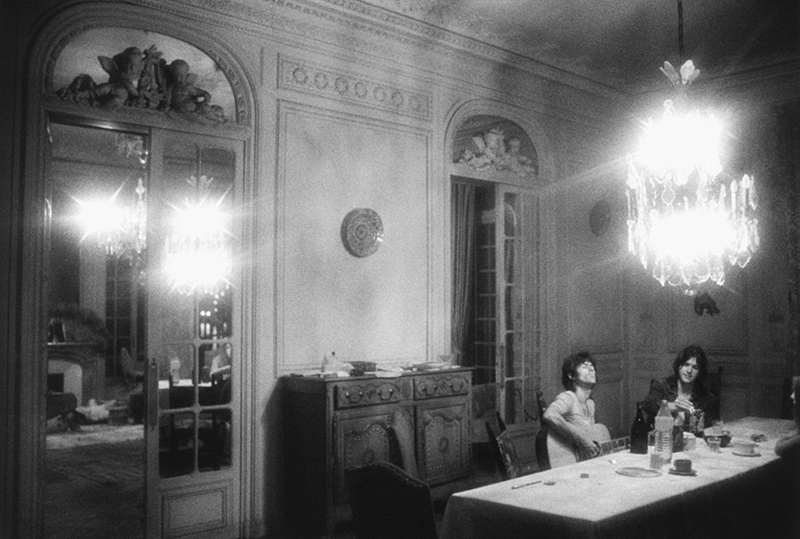
Kieth and Gram relaxing around the dining room table at Nellcôte.
Photo Source: https://sfae.com/Special-Pages/Search?searchtext=Nellcote&searchmode=allwords
“Casino Boogie” starts slow but partway through takes an energizing gulp of air and ends up being the fastest moving country tune on the record. Nicky Hopkins’ wistful keys dance at the beginning of the track and provide a degree of restfulness like you’d experience on a Saturday afternoon. But like how Saturday afternoon eventually gives way to the mania of Saturday evening, “Casino Boogie” increases in tempo. As the pace increases, Bobby Keys’ sax jumps to the forefront. Eventually multiple folks join in the jam and the tune takes on a honky-tonk dancefloor sort of vibe. Gram knew this style of honky-tonk well, leading me to think he was present, at least inspirationally.
“Torn and Frayed” appears near the middle of the album and is a perfect blend of country and rock that features twangy doses of Keith’s rhythm guitar paired with the steel guitar of Al Perkins. There is nothing contrived here, nothing stereotypical or superficially “country.” This seamless blend of genres is a Parsons’ trademark. As a listener you are unaware if it is rock or country, but you know it is American. The formation of the sound is as natural as friends passing time strumming guitars in a living room. The lyrics within “Torn and Frayed,” along with the other Exile on Main St. country tunes, elevate themselves from a hillbilly, dirt floor, sort of experience to an art form that expresses the myriad of joys and pitfalls life throws at a person. Again, “contributing to” and “influencing” are two distinct things, but the organic country sound, coupled with earnest lyrics, leads me to suspect Grams’ influence on “Torn and Frayed” was profound. Sadly, as the title indicates, “Torn and Frayed” speaks to painful situations and represents the fragile circumstances the Stones and Gram were navigating in 1972. Circumstances that were both caused and masked by the excesses of life at Nellcôte and as rock stars.
Within the villa, at least, Gram and Keith were in the throes of drug addiction. “Sweet Virginia,” the most down-home song on Exile, is a campfire’esque tune. Here again the country composition is natural and organic. But underneath the foot-tapping, sing-along veneer of “Sweet Virginia” is a song about heroin. Specifically, the tune sings of stashing heroin in your shoe, demonstrating one’s personal demons are never far from thought.
I want you to come on, come on down Sweet Virgina
I want you come on, honey child, I beg you
I want you come on, honey child you got it in you
Got to scrape that shit right off your shows
Excerpt From “Sweet Virginia”
Songwriters Keith Richards/Mick Jagger
Label: Rolling Stones Records
Gram Parsons died a little over a year after Exile’s release. Few have been as influential in so short a career. In less than a decade he contributed to, or recorded, a handful of classic records. In influence however, he lives in legend. In his brief career he turned country and rock on their heads, blending the two and eventually en route created “Cosmic American” music (often referred to as “Americana” today). Despite all this, his country’ish imprint on Exile might be his most notable achievement. Since “influence” can’t be quantified and his omission from the song credits glaring, the exact degree of his impact to the album will forever be debated. The question I ponder is whether Gram would relish living in legend, or feel slighted for not being formally recognized?
Spirituality and Exile on Main St.
Mack Rebennack, aka Dr. John, the jazz impresario familiar with the New Orleans/creole sound was amongst an agglomeration of incredibly talented musicians crammed into the villa. John Lennon also passed through and as already mentioned, Gram was there. With these sorts of folks, it is little wonder why Exile sounds so genuine and concertlike. But there was more afoot at Nellcôte than musical camaraderie, the Stones had a lot on their mind. Within the album you’ll hear songs that speak to and cry out to a higher power – Exile plays like a visit to church. Throughout Exile on Main St. the Stones live their faith. As evidenced by tunes like “Shine a Light,” “Let It Loose,” “Sweet Black Angel,” and “I Just Want to See his Face,” Exile is never far from spiritual thought. Faith, spiritual or otherwise, is in short order these days. For this reason, Exile’s message of faithfulness is as salient now as it was in the early 70s. The album is a reminder that a faith-filled journey will pay dividends not only for one’s soul but will also illuminate a path forward when you are stuck in dire situation.
When awful moments occur, moments I need not elaborate about because each of us is capable of conjuring our own painful remembrance; in these dark situations it is common to lash out, to wonder, “where is God in this situation?” This is what the Stones ask in “I Just Want to See His Face.” It is a plea to round a corner, a desire to have pain lifted, or a path illuminated that will offer escape from a lousy instance. We all need a guiding light from time to time. For the Stones, their gilded Mediterranean surroundings couldn’t mask the fact they were in exile. Pleasures within an arm’s reach yet addled with addiction and needs beyond instant gratification. It was a surrealistic but also confused time, a moment that seems perfectly reasonable to want to “see his face.” Charlie leads the song with drumming that supplants your heartbeat, but the singers (Mick and background vocalists) hijack the song, ushering the listener to what seems like an ancient tribal ritual. The ritual envelops you; a dream landscape where you are likely to interact with the eternal.
That’s all right, that’s all right, that’s all right
Sometimes you feel like trouble, sometimes you feel down
Let this music relax your mind, let this music relax your mind
Stand up and be counted, can’t get a witness
Sometimes you need somebody, if you have somebody to love
Sometimes you ain’t got nobody and you want somebody to love
Then you don’t want to walk and talk about Jesus
You just want to see His face
You don’t want to walk and talk about Jesus
You Just want to see His face (repeat 5 times)
“I Just Want to See His Face”
Songwriters Keith Richards/Mick Jagger
Label: Rolling Stones Records
Following “I Just Want to See His Face” in the tracklist is “Let It Loose,” a breakup song that I count amongst Exile’s spiritual tunes because Mick sings with an emotional depth that borders on religious fervor. The lyrics lay out a clear path – the only way out of a rotten situation is to move on, “Let It Loose.” Here the Stones remind us there is an emotionally healthy quality to leaving things behind. Of course, starting anew, letting “loose” is often easier said than done. For this reason we hear some of Mick’s most forceful singing on the album. Mick is singing straight from his heart to drive home the idea God (or someone you find of significance) has your back when you “Let It Loose.” This is a lovely song that reminds us there is always a path forward. “Let It Loose” is a breakup song, but it also reassures in the moments of consternation we will inevitably experience.
Symbolically speaking, “Loving Cup” could mean any number of things, including the obvious, an affair of the heart. With “Loving Cup,” the joy of an encounter is felt – there is no expense, no afterthought or regret, just joy. Like a sip from a “Loving Cup,” the moment is savored and shared.
I feel so humble with you tonight
Just sitting in front of the fire
See your face dancing in the flame
Feel your mouth kissing me again
What a beautiful buzz, what a beautiful buzz
What a beautiful buzz, what a beautiful buzz
Oh, what a beautiful buzz, what a beautiful buzz
Excerpt from “Loving Cup”
Songwriters Keith Richards/Mick Jagger
Label: Rolling Stones Records
“Loving Cup” resides amongst the religious leaning songs on Exile because it sings of endless bounty and inspiration, presumably provided by God. While not as commercially successful as other major hits of the Stones, it is a fan favorite, regularly played live, and is frequently covered. For example, and I apologize for gracing these pages with a Phish reference, but in Trey’s hands, they do a capable job with the tune. “Loving Cup’s” fame and longevity can be attributed to it’s earnestness. The song is so raw with emotion that a listen is almost cathartic. “Loving Cup” will inspire – it is the kind of song that ushers in happiness. Speaking of happiness…let’s step away from the spiritual for a spell to check in on Mr. Richards. We haven’t spoken much of Keith yet, which is curious this late in a Stones album review.
Situated directly in the middle of Exile on Main St. is “Happy,” a tune featuring Mr. Richards at lead vocals. “Happy” has the distinction of being a fast-paced Keith song. Aside from “Happy,” and “Before They Make Me Run,” from 1978’s Some Girls, Keith’s tunes tend to be slower and bluesier. In concert Mick typically sneaks off stage for a sip of water or wardrobe change leaving Keith at the helm for a couple of tunes. Providing more than respite, often Keith’s songs are the concert’s most intimate moments. As the title would indicate, “Happy” puts a smile on your face. For all of its fifty-plus years of existence “Happy” has been played live. “Happy” gets folks back on their feet and demonstrates Mick isn’t the only Stone capable of dictating tempo. There are many versions of “Happy” floating around, but the album version is perhaps the best – it is amongst the tunes on Exile where everyone is present and noticeably contributing. Another notable version of “Happy” is performed by Keith’s side gig, Keith Richards and the X Pensive Winos. The Winos are just straight forward rock and roll and have damn near blown the roof off any club they’ve played. Kieth’s solo shows are also timely because the offer a preview of the Stones’ second drummer, Steve Jordan, who took over after Charlie Watts’ passing in 2021.
Time to Roll the Dice
One of Exile’s and the Stones finest songs is “Tumbling Dice.” Wrapped in the language of a gambler, the song is thick with casino inspired imagery where the subject of the tune is almost begging a would-be lover to “Tumble the Dice” and allow themselves to into a romantic encounter. The song ranks amongst my favorites. In fact, it seesaws with “Loving Cup” for the title of my favorite Stones song. Which I find amusing because gambling and careless, unattached love have never been my choice of misdeeds. My sin de jour involves ale, piney smelling spirits, brown booze, or really anything poured in a glass…jeepers do I enjoy a drink! Basically I’d be at the bar in the casino, with my back turned to this encounter, oblivious to the dancing of the bees behind me. Instead, what I pull from the song is metaphorical – the “Tumbling Dice” are akin to the tosses and turns of life.
There is perhaps no better example of living in the moment than a dice roll. Just a handful of seconds, but as the dice tumble, time stands still. Time reflects your wager. If your bet was stereotypical (a monetary wager), the dice tumble quickly, judging you bet within your means. Your wager might be large; for example, where to go with a relationship. In this sort of moment the dice roll slowly, especially if the participants have a lot of time shared between themselves. Perhaps you are pondering a career move, that too is a slow roll. “Tumbling Dice” is the flipside of the coin from “Let It Loose” – both songs encourage us to tumble the dice, roll with the punches, “let loose.”
Honey, got no money
I’m all sixes and sevens and nines
Say now baby, I’m the rank outsider
You can be my partner in crime
Baby, I can’t stay
You got to roll me and call me the tumblin’
Roll me and call me the tumblin’ dice
Now baby
Oh my, my, my, I’m the lone crap shooter
Playin’ the field ev’ry night
Baby, I can’t stay
You to roll me and call me the tumblin’ dice (Call me the tumblin’)
Got to roll me (ya yes), got to roll me, got to roll me (Oh yeah)
Got to roll me…
Excerpt from “Tumbling Dice”
Songwriters Keith Richards/Mick Jagger
Label: Rolling Stones Records
With “Tumbling Dice,” here again we have an all-out effort by the album’s contributors. Mick, as is customary, delivers muscular lead vocals. Gram is again felt in the easy country form of “Tumbling Dice,” manifested by Mick Taylor’s steel guitar. Backing vocals by Clydie King, Venetta Fields, and Sherlie Matthews provide an inspirational, choral-like quality. Take note – inspiration isn’t always in the vein of celebration. Often inspiration is a nudge towards action, nourishment enabling someone to tackle a difficult task. For this purpose the Stones provide us with “Sweet Black Angel.”
“Sweet Black Angel,” a tune that addresses the misdirected imprisonment of political activist Angela Davis, is a rare venture into the political sphere for the Stones. Simultaneous to its political message, the song brings forth an important spiritual message, reminding us that Saints toil amongst us and often the causes they espouse are counter-cultural. Angela was a strong voice for black empowerment and an avowed Marxist. In 1972, like 2023, those causes could land you in a cauldron of trouble. Angela was frequently at odds with the “powers that be” and subsequently the political establishment wasn’t keen on Davis. Eventually she found herself falsely tried for murder. While never explicitly naming Davis, “Sweet Black Angel” points out the injustice of her incarceration and shines a light on the injustices the virtuous in our communities frequently encounter. Without directly naming Davis, some criticize the opaque nature of the lyrics as being limp-wristed. Quite the opposite, I feel there’s strength in the opacity as the listener is invited not only to feel Davis’ suffering, but also explore where injustices play out in their own life, essentially expanding the scope of the song beyond Angela Davis.
She countin’ up de minutes
She countin’ up de days
She’s a sweet black angel
Not a gun toting teacher
Not a Red lovin’ school mom
Ain’t someone gonna free her
Free de sweet black slave
Free de sweet black slave
Excerpt from “Sweet Black Angel”
Songwriters Keith Richards/Mick Jagger
Label: Rolling Stones Records
Effective in conjuring sympathy for Davis and allowing the listener to imagine how they might act in her circumstances, “Sweet Black Angel” is a triumph of a song. Unlike “Street Fighting Man,” the Stones most famous political tune, “Sweet Black Angel” is lighter, almost to the point of folk. The instrumentation is straightforward and could be replicated anywhere. Don’t waste it, “Sweet Black Angel” is a call to action. Like Davis’ voice who was no stranger to rallying a crowd, “Sweet Black Angel” is the sort of tune that could ignite a union hall, be cried out in a village square, or heard on the steps of a Capitol.
“Shine a Light” – Let’s Return to Our Pews
“Shine a Light,” the final of the album’s gospel inspired, religious leaning songs leaves, us on a high note. After all, what is the point of faith without salvation? Here Mick is matched by Hopkins who strikes his piano keys so hard the sound is almost percussive. Organ and background singers join the ranks and spread joy with their voices, like a million-member choir. Bill Wyman is heard on bass, and we’re graced with trademark guitar work of Taylor and Richards…add it all up and you have an eruption, a full-blown celebration! “Shine A Light” is a Pentecostal, Easter Sunday sort of celebration – an expression of triumph. Your struggles are not in vain, as Mick proclaims, God will eventually “Shine a Light,” on you, “like an evening sun.” A few albums back “You Can’t Always Get What You Want” assured us you’ll “get what you need;” “Shine a Light” reminds us of that promise.
The album could have concluded with the frenzied celebration of “Shine a Light” and no one would have been at a loss. The case for Exile’s inclusion amongst monumentally classic records was already firmly established by a slug of fantastic songs. I don’t know about you, but I exhale after I digest a monumental record; my brain desperately seeks calm. My heartbeat is usually a mess too…everything is scrambled in the wake of a classic album! A handful of deep breaths begins the process of getting everything back on track. How fun it is to feel your body thrown off kilter by art…homeostasis be damned! Exile, after “Shine a Light,” leaves me in such a state – nervously exhausted and excited. But where other albums would end, Exile on Main St. provides one more track, “Soul Survivor.” Another in the ranks of Exile’s aptly named tunes, “Soul Survivor” somehow hangs on, appearing at the end, but on the record nonetheless. It is an audacious and perhaps unnecessary venture to tag on a song after “Shine a Light,” but here’s the thing…it’s a good tune! I think “Soul Survivor’s” value is that it helps you decompress. Lesser classic albums would end, leaving the listener in the flummoxed state I just spoke of. On Exile, “Soul Survivor” guides you through that disoriented moment.
My Exile Experience
A few years back, five hours of open highway separated me from Ada, Minnesota, where I was bound to attend a friend’s wedding. Fortunately, Cheapo Records was on my way out of town, helping ensure I’d be equipped with proper entertainment for the journey. Fairly new to the Rolling Stones, I was thirsty for recommendations. Joe advised me to pick up Exile because “that’s the one they always talk about.” Twenty dollars lighter, but with Exile on Main St. in hand, and pack of Camel Lights on the dashboard, I started down 262 miles of smoothly maintained Minnesota highway. The needle on the speedometer pointed towards “you’re an idiot” for most of the voyage. Right from the start “Rocks Off” belted out of the speakers and no matter how heavily I stepped on the pedal the tune galloped down the highway in front of me. “Tumbling Dice,” “Loving Cup,” “Let It Loose,” “Sweet Virginia” – all of it, I took it all in…the time between Ada and Saint Paul has never been shorter. My drive was a concert. Exile immediately became the standard of which I judged other albums.
A collection of enjoyable songs that play well together; sure, Exile is that. An awesome agglomeration of tunes, coupled with the experience of a carefree summertime jaunt down a highway is more than enough of a reason for the album to register as a classic for me. But as I’ve been blessed with years, I have also been gifted with more interactions with Exile. Each listen endears me more to the album. For example, with a recent listen, Bobby Keys’ saxophone tugged at my brainstem like never before. Why Exile on Main St. is so enduring I believe lies within the religious leaning songs. The Stones on Exile don’t deal in hard to digest moral or spiritual topics like punishment, redemption, piety, or free will. Instead, the spirituality they ponder is easy to approach. The Stones simply speak to the need for faith and drive home the idea that you are never alone – the entirety of Exile is reassuring. It is almost as if the mission of Exile is to let you know God (or whatever support structure you prefer) is comforting you, always in your corner. There is depth, cheer, celebration, hope, and comfort in these songs.
When you’re drunk in the alley, baby with your clothes all torn
And your late night friends leave you in the cold gray down
Whoa, just seemed too many flies on you
I just can’t brush ‘em off
Angels beating all their wings in time
With smiles on their faces and a gleam right in their eyes
Whoa, thought I heard one sigh for you
Come on up now, come on up now, come on up now
May the good Lord shine a light on you
Yeah, make every song you sing your favorite tune
May the good Lord shine a light on you, yea
Warm like the evening sun
Excerpt from “Shine a Light”
Songwriters Keith Richards/Mick Jagger
Label: Rolling Stones Records
Billy Preston, a slew of backing vocalists and musicians, and the afore mentioned Dr. John and Gram Parsons – it is entirely possible, with the crew assembled for the album and mixing sessions in Los Angeles, that the gospel feel of Exile was a natural sound for them to produce. These were folks who were children of or lived in the American South. These talented performers were conversant in the blues, soul, as well as Pentecostal and gospel influences. Thus, it is reasonable, given their participation, and the Stones’ interest in American music, that the album would assume it’s soul-filled, gospel semblance. However, every flip of the vinyl reveals a different spiritual tune; the message of salvation, grace, and wonder is woven throughout. I simply believe there is too much of a saintly presence for the religious feel to be a coincidence.
There’s Just as Much to Argue About in 2023 as in 1972
There is a lesson buried within Exile on Main St. and it is a message as salient now as it was in 1972. Rock and roll, we take for granted nowadays, but at the time of Exile, rock was very much the mouthpiece of the counterculture. With their stature in popular music, the Stones were extremely influential. As such, their fame landed them in the unique position of being at the eye of the hurricane, at the vanguard of the “counterculture.” Whether or not their tunes and actions actually supported that reputation is a discussion to be endeavored another time. Regardless of what they sang, or why they sang it, the aura of youthful expression and rebellion surrounded the Stones. What is certain is that the late 60s and early 70s were similar to our times in the sense there were forces hellbent on dividing society into camps.
Throughout Exile there is abundant innuendo, be it sexual or about other excesses, but those moments are buoyed by songs of enduring love and religious exploration. Enduring love and religious exploration hardly sound like the causes championed by people pushing for societal upheaval. Instead, those themes sound like the work of youthful adults trying to navigate an imperfect world, ruminating about their way forward. At their most vulnerable, exiled, we find these supposed “countercultural warriors” exploring their religious faith. Religion – an institution, certainly not exclusive to, but more often associated with the right side of the political spectrum, the side most interested in tradition.
Exile on Main St. – recorded amongst friends, in a setting without veneer, is an album where the Stones true selves shine brightly in the easy flow of the songs. The organic sound and religious-inspired songwriting of Exile on Main St. is a reminder we are all a complicated blend of traditional and progressive virtues. Sure, we vote in a certain direction, but the desire, to be labeled or label others as “conservative” or “liberal” is a fool’s errand. Recognizing our personal mixture of traditional and progressive underpinnings is a concept at the core of Exile on Main St. That hardly sounds like the kind of proposition a band striving for cultural reconfiguration would include in an album.
Pick Up Those Dice
The Stones have always been a band to, as Frank would say, “do it their way.” Their albums, spare a couple in the mid-60s when they were arguably chasing the Beatles, have always been recorded on their terms. I’m not mentioning this as critique; their formula has produced handfuls of classic records and a catalog rivaled by only a select few. But in the middle of their impressive musical canon, for me, there has always lingered the question, “why is Exile better than the rest?” Numbers wise it is pale, the albums surrounding Exile all had #1 hits. Exile’s chart toppers plateaued at #7 (“Tumbling Dice”), and #69 (Happy). But like Mr. Parsons, Exile lives in legend. Its strength is in its vulnerability. The Stones invite you into Nellcôte; the songs are as revealing, unforced, and effortless as a conversation between friends…organic. While the pop charts might not have strongly embraced Exile, music fans revel in the album because with emotions laid bare, Mick and company are immediate and identifiable. As we move on from 1972 the Stones will rarely occupy a small stage. But with Exile, they are still on that small stage, the sort of stage where your applause stands out, a stage where you feel like a part of the experience. Being the intimate album it is, an album that invites the listener into an unpolished experience with the Stones, it makes sense that there is no ideal scenario or time to enjoy this album. Quite simply: anytime, anywhere and with anyone will suffice. That is a hallmark for many classic albums, they are vastly approachable. But perhaps most importantly, recorded amongst friends, maybe the ultimate lesson to take away from Exile is to share your space and roll those dice…
Sources and Shout-Outs
- Many, many thanks for your patience in waiting for this review. Honestly, it belched out of my mind fairly quickly, only taking about a week to write. But I found that editing something written that quickly is no small task! Speaking of editing…
- The person who helps me edit these articles wishes to remain anonymous…probably he or she is smart enough to remain under the radar when Mick sues Andy’s Stones. Nonetheless, I want to say a big thank you for helping edit. As I already said, it was a big haul this go round!
- I have had many interactions with folks and Exile on Main St. through the years. So many in fact that I thought about reviewing the album through the lens of these interactions. I ditched that idea, obviously, but here’s a list of people I share pleasant memories of Exile with: Joe, TK, Kyle, Brad, Michael, Travis and Lou (who you’ll hear from in the Postscript). Speaking of the Postscript…
- There are countless side stories relating to this album. So don’t be surprised when I circle back in about a week with what will be a lengthier than normal postscript.
- For those on receiving the Print Edition of Andy’s Stones: It will be in the mail sometime this week!
- Sources:
- Album Info (i.e. release dates, track listings, label info) was retrieved from the Exile on Main St. Wikipedia page https://en.wikipedia.org/wiki/Exile_on_Main_St.
- Nellcôte Photos Retrieved From https://sfae.com/Special-Pages/Search?searchtext=Nellcote&searchmode=allwords
- Villefranche-sur-Mer Photos Retrieved From https://frenchriviera.travel/villefranche-sur-mer/
- Info About Earlier Recording Sessions (Sticky Fingers): https://en.wikipedia.org/wiki/Exile_on_Main_St.
- Info About Earlier Recording Sessions (Sticky Fingers): https://timeisonourside.com/lpExile.html
- Information and Quotations About “Ventilator Blues” Retrieved From According to the Rolling Stones. Chronicle Books. p. 159. ISBN 0811840603.
- Info About Participants and Contributing Musicians Retrieved From https://timeisonourside.com/lpExile.html
- Information about Angela Davis Retrieved From https://wams.nyhistory.org/growth-and-turmoil/feminism-and-the-backlash/angela-davis/
| Track # | Title | Notes |
| 1 | Rocks Off | |
| 2 | Rip This Joint | |
| 3 | Shake Your Hips | * |
| 4 | Casino Boogie | |
| 5 | Tumbling Dice | ! |
| 6 | Sweet Virginia | + |
| 7 | Torn and Frayed | + |
| 8 | Sweet Black Angel | B |
| 9 | Loving Cup | ! |
| 10 | Happy | ! |
| 11 | Turd On the Run | |
| 12 | Ventilator Blues | * |
| 13 | I Just Want to See His Face | + |
| 14 | Let It Loose | + |
| 15 | All Down The Line | B + |
| 16 | Stop Breaking Down | * |
| 17 | Shine a Light | ! |
| 18 | Soul Survivor |
Exile on Main St: Released 05/12/1972 by Rolling Stones Records – reviewed by Andy Trcka of Andy’s Stones
Legend: ! = hit, single or famous track, B = B-side to single, + = top track recommended by Andy’s Stones, * = Songwriting credits = Robert Johnson (“Stop Breaking Down”), Slim Harpo (“Shake Your Hips”), Mick Jagger, Kieth Richards and Mick Taylor (“Ventilator Blues”), all other songs written by Mick Jagger/Kieth Richards
 gramsghost.com